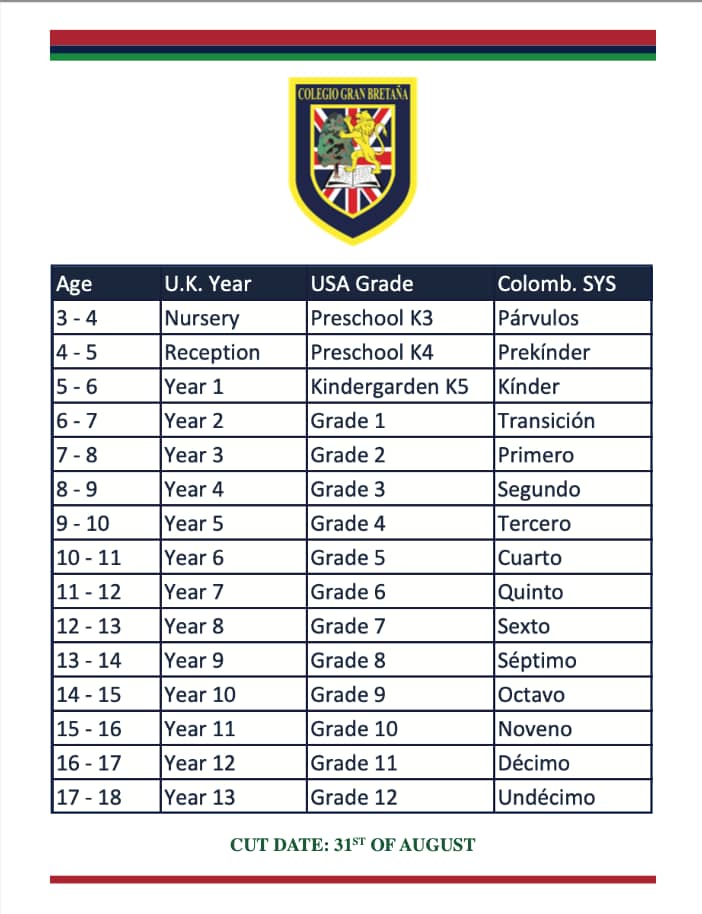
CGB's FAQ

 General School Questions 

         What type of school is CGB / does it have a profile?              
         How big is CGB? 
         What role does the PTA play at CGB?
         What role does the School Board play at CGB?
         What is Jeans Day?
         What is Bake Sale?

 The International Baccalaureate (IB)

        What is the IB? 
        What is the IB Learner Profile?
 
Admission Process
 
         How do I apply to CGB? 
         What forms do I have to fill out? 
         When do I have to turn in forms?  
         Can I use a credit card?  
Post Acceptance
 
Registration 
         Who do I talk with for this process?
         How do I process payment? 
Materials 
•         Where do I get a materials list?  
Uniforms 
         Where do I get a uniform list?  
         How do I pay for uniforms? 
         Where do I get the uniforms? 
Cafeteria Service 
Bus Service – Beatriz/Sonia
         Do we have to use the bus service?  
         What is the transportation policy?   
         Is the service door to door? 
Extra-curricular programs 

CGB’s FAQs 

General School Questions
 
         What type of school is CGB / does it have a profile?              
  • It is the only school in Colombia where the medium of instruction is English as a first language.
  • It is the only school in Colombia with a double international accreditation: NEASC (New England Association of Schools and Colleges) and CIS (Council of International Schools).
  • It is the only school in Colombia with a truly international student and staff population.
  • It offers Nursery to Year 13 (UK) in a small, tranquil and rural environment where the total student population is 330 and the average class size is 15 students.
         How big is CGB?
  •  360 students 
  • CIS
The Council of International Schools is the premier worldwide accreditation organisation for international schools. The CIS Accreditation Service manages a peer to peer Accreditation Programme which encourages school improvement through a process of continuous self-study and peer evaluation. Working in partnership with member schools it sets the standards for International Education as laid out in ‘The CIS Guide to School Evaluation and Accreditation’.
The final award of full accredited status demonstrates that the member school has achieved high standards of professional performance in international education and has a commitment to its continuing improvement.
Heads and teachers from member schools play an active role in assessing and evaluating the progress of peer institutions as Visiting Team participants and over the rest of the accreditation cycle, sharing knowledge and Best Practice ideas.
  • NEASC (Improving Education Through Accreditation)  
Founded in 1885, the New England Association of Schools & Colleges, Inc. (NEASC), is the nation’s oldest regional accrediting association whose mission is the establishment and maintenance of high standards for all levels of education, from pre-K to the doctoral level.
NEASC serves more than 2,000 public and independent schools, colleges and universities in the six states of Connecticut, Maine, Massachusetts, New Hampshire, Rhode Island and Vermont and American/international schools in more than seventy nations worldwide.
“The accreditation process we have developed over the years is a major vehicle that can and should be used to bring about educational improvement at all levels of schooling,” says Jacob Ludes, III, Executive Director and CEO of NEASC. “NEASC is poised to be a partner in the effort to reform and improve education in the region.”
Accreditation: a Process of Systematic Improvement. Accreditation relies on a voluntary, peer review process, engaging some 3,400 educators in the region on hundreds of reviews in any year. Each relies on a 12 to 18-month self-study process undertaken by schools and colleges in regular review cycles. The goals are school effectiveness, improvement and public assurance. Unlike popular magazines, this does not involve ranking institutions, but rather, establishes a level of acceptable quality for all accredited institutions.
  • 38% Colombian
  • 14% U.S.A.
  • 7% British
  • 41% made up of 23 other nationalities
  • CGB is a small school and therefore children get to know each other very well, not only with their own classmates but with students of other classes. Colombian children are excellent hosts. They establish a brotherly atmosphere which results in a prompt integration for foreign students and friendly relations amongst them.  
         How do foreign students in general feel about life at CGB?         
  •  The adaptation process for foreign children is a fast and easy one at CGB. Children create tight links with their friends and generally express their contentment with the institution. It is usually very hard for foreign children to leave the school after two or three years and, when they have the opportunity, they come to pay a visit.  
  • The school has a 24 hour guard which is out sourced from a reputable security company. The school also has care takers who live on campus. All visitors must sign in at the main gate and wear a visitor’s badge. CGB has a low profile in order to lower security risks. 
  • Depending on their interests and ambitions, the subjects of our IGCSE and high school examination (currently, AS and A levels and in the near future, the IB Diploma programme) cater to the needs of the majority.

Our Secondary Section is still relatively young and we have had only a few students graduating from CGB. Currently, we have 3 students who are in Los Andes (the top private university in Colombia). Two are studying Engineering and one is doing Social Sciences. Another student is in Dublin, Ireland, doing Business Studies. 

A student who left us a couple of years before graduating, when his family had to return to Canada, is now in the University of Toronto. 

  • Parents play a critical role at CGB. The school prides itself on its reputation as a community school. Workshops are regularly held for parent information across the school. Previous workshops have included “Helping your child at home”, “The Importance of Routines”, “Bullying”, “Numeracy”, “Eating Well” etc.  
Our parents like to get involved in the day-to-day organisation in a wide variety of ways. We currently have Mums working with our Art Teacher, Library Assistants, Listening Ears for reading, organising and running Scrap-Book making as a co-curricular activity, and regular cooking activities. Bake Sales are a regular feature at CGB.
 
In addition to these we have parent representatives on our active Values’ Committee and our Charity Committee.
 
Parents have representation on our Advisory Board and the school has a vibrant PTA. The role of Class Representative disseminates a variety of information from birthday parties to emergencies. 
  • The Parent Teacher Association at Colegio Gran Bretaña exists to support the work of the school, to develop a community spirit among its members, and to raise extra funds for special purchases.
Events supported by the Parents’ Association in recent years have included Bingo Supper, Quiz Night, Christmas Concert, and other social gatherings. Welcoming coffee mornings are held from time to time to enable new parents to meet each other as well as existing parents. A regularly published letter is sent home with each student to keep parents up to date as to the goings on of the Parent Teacher Association.

The Committee of the Parents’ Association consists of six parents (elected annually) and one teacher. Elections are held in June for the following school year. Regular meetings of the Committee act as a possible channel for comments and queries from parents to the school. There is an annual membership fee per family.
  •  The Advisory Board 
Advisory Board members serve a one-year, renewable term of office. The 12- month term is from October through September. The working language of the Advisory Board is English. Every effort shall be made to identify Advisory Board members who collectively reflect the diversity of the school. The composition of the Advisory Board is as follows:  
    • The CGB Director
    • The CGB Vice Rector
    • Two delegates named by the Board of Directors (one of these shall be the General Manager and the other shall be a member of the external community).
    • Two faculty members, elected by the faculty. One of these shall be a foreign-hired faculty member, and the other shall be locally hired.
    • One student representative (chosen by the secondary school students)
    • One ex-alumni
    • The Public Relations Officer of the school (who also serves as the secretary of the Advisory Board)
    • Two parents, named by the PTA. One parent shall be foreign and one shall be Colombian.
    • The PTA President
    • Two representatives of the international business community. One of these shall be named by the British Petroleum Company and one shall be named by Schlumberger. It is not necessary that these representatives have children in the school.
    • The British and U.S. Ambassadors to Colombia shall each name a representative to the Advisory Board. It is not necessary that these representatives have children in the school. 
With the exception of the Director and the General Manager, each member of the Advisory Board may be represented by a substitute on those occasions when s/he cannot attend a meeting. Substitutes may participate freely in the discussions, but shall not be permitted to vote.
 
The Advisory Board provides advice and support to the Director of the school. The general responsibilities of the Advisory Board include: 
    • Promoting the philosophy and objectives of the school
    • Setting school policy
    • Approving the annual objectives of the Director 
    • Providing an annual evaluation of the Director to the Board of Directors
    • Appraising its own performance on an annual basis
    • Supporting the development of long-term plans for the school
    • In accordance with Colombian law, providing preliminary approval of any increases in fees 
         What is Jeans Day? 
  • The Parent Teacher
    Students and teachers are permitted to come to school once a month in casual clothing. The cost is   
    $2,000 or other donations depending on the cause. The proceeds go to Primary and Secondary 
    Student Councils and/or other worthy causes. Jeans Days usually occur on Fridays – please  refer to the calendar on the website or to your child’s student diary.


        What is Bake Sale? 
  • Bake Sales often take place in conjunction with Jeans Days, although they can take place at any time during the year. Snacks, potato chips, sweets (candy) and soda drinks are sold to students at break times. Bake sales are run by the students in order to raise funds for worthy causes. The PTA also runs a Bake Sale from time to time. The school suggests sending in no more than $5,000 Colombian pesos for Bake Sales.


The International Baccalaureate (IB)

        What is the IB? 

  • "The International Baccalaureate (IB) offers high quality programmes of international education to a worldwide community of schools. The IB is a nonprofit educational foundation, motivated by its mission, focused on the student. Our three programmes (Primary Years Programme – age 3-12, Middle Years Programme – age 11-16 and Diploma Programme – age 16-19) for students aged 3 to 19 help develop the intellectual, personal, emotional and social skills to live, learn and work in a rapidly globalizing world.
     
    Founded in 1968, we currently work with 2,261 schools in 126 countries to develop and offer three challenging programmes to over 602,000 students aged 3 to 19 years. The International Baccalaureate (IB) Diploma Programme is a challenging two-year curriculum, primarily aimed at students aged 16 to 19. It leads to a qualification that is widely recognized by the world's leading universities.
     
    Students learn more than a collection of facts. The Diploma Programme prepares students for university and encourages them to:
    • ask challenging questions
    • learn how to learn
    • develop a strong sense of their own identity and culture
    • develop the ability to communicate with and understand people from other countries and cultures.
    Schools teach the programme in English, French and/or Spanish."

     
    The curriculum contains six subject groups together with a core made up of three separate parts.
     
    For more information, please visit the school IB link at: http://www.cgb.edu.co/Programmes/IB/ or the IBO website at: www.ibo.org


        What is the IB Learner Profile? 

  • The IB learner profile provides a long-term vision of education. It is a set of ideals that can inspire, motivate and focus the work of schools and teachers, uniting them in a common purpose.
     
    IB learners strive to be:
     
            Inquirers
            Knowledgeable
            Thinkers
            Communicators
            Principled
            Open-minded
            Caring
            Risk-takers
            Balanced
            Reflective
     
    Read about the full IB Leaner Profile at:


Admission Process

        
Who coordinates the admission testing process? 

         Who is the first contact in the admissions process? 

  • The school receptionist if you call the school, or the admissions officer, Fiorella Rocha, directly through her e-mail: admissions@cgb.edu.co  

         How do I apply to CGB? 

    1. If you are in Bogotá, get in contact with the school at 676 0391 or e-mail admissions@cgb.edu.co in order to arrange an appointment to visit the school. 
    2. Fill in the Registration Form (available on the school website) and send it to the admissions officer: admissions@cgb.edu.co  
    3. Set an appointment for admissions exams, interviews and observations. Parents and student(s) must come. You should bring with you the following documents: 
Ø      Completed Registration Form, to be found on www.cgb.edu.co (if you still have not sent it)
Ø      1 colour photograph
Ø      Transcripts
Ø      Birth certificate or ID, and a copy of the passport
Ø      Bank reference, income certificate, and /or company letter
Ø      Admissions Fee: $25 US Dollars
Ø      Completed Teacher’s Recommendation Form (Also on the web page)
Ø      The completed “Medical Form” (Also on the web page). This will be required when registering 

         What are the first steps in the application process? 

  • Contact the school, fill out the Registration Form and send it to the admissions officer: admissions@cgb.edu.co
  • Have your child’s teachers fill out the Teachers’ Recommendation Form, and set an appointment for exams, interviews and observations.

         Is there a timeline for the admissions process we should be using? 

  • Admissions are accepted throughout the whole year. However, it is better to do this process at least 5 months before the date of entry as to find spaces available. 

         What forms do I have to fill out? 

  • You must fill out the Registration Form (to be found on www.cgb.edu.co). The school also requires the Recommendation Form that must be filled out by your child’s teachers.  

         When do I have to turn in forms?  

  • The Registration Form must be sent as soon as possible to the admissions officer. The Teachers Recommendation form(s) must be handed in on the day in which the appointment is set for interviews and admissions exams. 

         Can my child take his or her admissions test outside of Colombia prior to arrival? 

  • Yes, in almost all cases. However children under 6 years of age and children with Special Needs must do the process at the school. 

         If so, how is this done?  

  1. The Registration Form must be sent to admissions@cgb.edu.co   
  2. Parents must send to the admissions officer, admissions@cgb.edu.co, all the information of the school that will be in charge of administering the tests to the children, and the name of the person in charge
  3. Colegio Gran Bretaña sends the tests through e-mail.
  4. The school that administers the tests must then send them back to Colegio Gran Bretaña in a sealed envelope (mailing costs are assumed by parents) to:
Colegio Gran Bretaña
Cra. 51 No. 215-20
Bogotá, Colombia
  1. Colegio Gran Bretaña will check results and contact parents to provide results.  

         Do I have to pay for the admission process, and if so how much is it?  

  • Yes $25 US Dollars or $50,000 Colombian Pesos. 

         How can I pay for the admissions process?  

  • You can pay in an international school account (the receipt must be sent by fax: 57.1.676 0426) or directly in the school office 

         Can I use a credit card?  

  • No 

         What documents does CGB need us to bring to Colombia for the admissions and registration process? 

  • Completed Registration Form, to be found on www.cgb.edu.co (if you still have not sent it)
  • 1 colour photograph
  • Transcripts
  • Birth certificate or ID, and a copy of the passport
  • Bank reference, income certificate, and /or company letter.
  • Admissions Fee: $25 US Dollars.
  • Completed Teacher’s Recommendation Form (Also on the web page)
  • The completed “Medical Form” (Also on the web page). This will be required when registering 

         What documents do I need from my current or old school?  

  • Completed Teacher’s Recommendation Form (Also on the web page) filled out by the teachers.
  • Transcripts:     

 Nursery & Reception: Preschool reports
 Year 1 – Year 8: Last two or three years of schooling
 Year 9 & above: Official sealed transcripts 

Post Acceptance


Registration


         How do I register / enroll my children once they have been accepted? 

  • You must complete the school contracts (Educational, Transportation, Cafeteria) which may be sent by e-mail, and hand them in together with the payment. 

         Who do I talk with for this process? 

         How do I process payment? 

  • Payment can be made directly at the school
  • Payment can be made directly to the school account
  • The school may liaise directly with a company, if it is assuming the school fees 

Materials


•          Where do I get a materials list? 

  • Parents pay a yearly fee for materials and these are provided by the school. (This fee also includes books in English and in Spanish). However if parents require the list, it will be provided.  

•          How and where can I pay for materials? 

  • Materials are paid together with the Registration Fee. 

•          Can I pre-order materials prior to arrival? 

  • There is no need. 

Uniforms


         Where do I get a uniform list?  

  • You can find it in the school’s Parent Handbook or at Jubalai (Calle 94A No. 11A-36, tel. (571) 6219221, (571) 6219074) 

         How do I pay for uniforms? 

  • At Jubalai, the uniform store. 

         Where do I get the uniforms? 

  • Jubalai, located at Calle 94A No. 11A-36, tel. (571) 6219221, (571) 6219074 Bogotá.
  • The P.T.A. also sells 2nd hand uniforms. 

         Can I preorder the uniforms prior to arrival?

  •  You may, if you are really sure of your children’s sizes. 

Cafeteria Service


         Does my child have to use the cafeteria services? 

  • All CGB students have to use the school’s cafeteria service because we care and are interested in our students receiving healthy and properly balanced food. The school has organised the “Food Committee” with parents, teachers, students and administration members who discuss and decide about tasty and nutritious menus. If your child requires special food or a different diet following medical prescription, we are able to provide it.  

         How do I sign my child up for the cafeteria service? 

  • The service is compulsory so there is no need to sign up. 

         How do I pay for the cafeteria service?  

  • At the accounting office. 

Bus Service – Beatriz/Sonia


         Do we have to use the bus service?

  •  No. The use of the transportation service is left to personal choice. 

         What is the transportation policy?  

SCHOOL TRANSPORTATION POLICIES 
a)      Transport changes must be requested before 10:00 am, in order to make sure they can be done. Requests must be sent in writing in the homework diaries, by means of personal notes or via fax (6760426), followed by confirmation. This procedure must be followed also in case of parties or special events.  
b)      If you or another person is picking up your child and you have not informed the school in advance, you must come to school 30 minutes before the departure time and inform the transportation office.
c)      Drivers, bodyguards or any other authorised person must have a school card to be presented when requested. Please request your card at the Supplies and Transportation Office.
d)      We ask parents and authorised persons to be at their pick up place five (5) minutes before the established schedule, to leave and to pick up the students. Please remember that a delay of 1 or 2 minutes per student may cause inconveniences to other parents and to the school schedule itself. The bus will wait for only 2 minutes at each bus stop, in the morning and in the afternoon. In case there is nobody waiting for the student in the afternoon, the bus will continue and the student will be taken to Lidertran’s[1]* office, where the child must be collected by his parents.
e)      Please remind your child that the driver and his assistant are in charge of the discipline in the bus and that they must be obeyed always. Students are not allowed either to open or lean out of the windows without the driver’s or his assistant’s consent, or by any means to throw objects at other vehicles. 
f)        Students are permitted to eat in the buses as long as they do not leave the trash in the bus. Buses must kept clean.
g)      Buses can sometimes be late due to traffic congestion or severe weather conditions in Bogotá. It is impossible for the school to call all families to inform them about late arrivals. We will therefore send e-mails informing about a specific situation, when necessary. We encourage parents to check their e-mail accounts if the bus does not arrive as scheduled.  

         How do we sign up for bus service? 

  • Parents must sign a contract with the school. The contract describes service conditions, costs and the grounds for its termination. 

         How long do the routes typically take?  

  • Routes take between one hour and one hour fifteen minutes, including delays of parents in picking up their children and traffic congestion.  

         Is the service door to door? 

  • Yes. 

         What security measure does CGB take for the bus service?  

a.       The use of security belts is mandatory.
b.      Children are not allowed to open the windows.
c.       The name of the school does not appear on the buses.
d.      Drivers and assistants maintain the same route, in the morning and in the afternoon.  

         Can I see photos of the buses?  

  • Yes, they are permanently available on CGB’s web page: www.cgb.edu.co 

         How do I get a car pass for my private car?  

  • CGB provides a card to parents and/or to persons authorised to pick up their children. Cards include information of the holder and of the vehicle and must be signed by parents/guardians. The school will ask for the card at any moment to allow the students to leave.  

Extra-curricular programs


         What activities are offered within the extracurricular program? (Training, enrichment, Condor, etc.) 

  • Activities offered in the four different cycles have included: soccer, rugby, fencing, field hockey, roller hockey, basketball, volleyball, tennis, horse riding, table tennis, Taekwondo, karate, drama, story club, arts & crafts, cooking, fashion design, Mandarin, homework club, jewellery design, scrap booking, mini-golf…. 

         Which extracurricular activities cost money and which ones do not? 

  • Activities taught/coached by CGB teachers generally do not have a cost unless there are materials required or the activity takes place off campus. Where external coaches are used, there are costs involved.

         Which extracurricular activities require the purchase of materials / supplies / resources? 

  • Activities such as arts & crafts, roller hockey, horse riding, scrap booking, fashion design, cooking…… 

         What competitive High School sports are currently offered at CGB? 

  • CGB plays sports against schools in the ACB League (Association of Bilingual Schools). Sports include soccer, basketball and tennis. These matches are more based on participation and meeting other students than on fierce competition. 

         Does CGB have Junior Varsity and Varsity sports? 

  • No.

__________________________________________________________

 [1] Lidertrans: Calle 40 No. 21 A – 17, of 202. Teléfono 245 13 66, 3380873